A real-time strategy game I’ve wanted to play since I was a kid, so I made it
Game design, art direction, UI Godot 4 · Blender · October 2026
Okay so this one’s personal. Two games basically raised me: Warlords Battlecry III and The Settlers III. One is all heroes, spells and armies smashing into each other. The other is this weirdly calming thing where you watch tiny people carry logs to a sawmill for hours.
I always wanted both in one game. Nobody made it. So I did.
What
A real-time strategy game for Mac and Windows
My role
Game design, art direction, UI, playtesting (a lot of playtesting)
Built with
Godot 4, Blender, Figma
Timeline
A lot of weekends in 2026
The idea
The pitch I kept repeating to myself was this: you build a society that can sustain a war machine, while you command that war machine.
Every resource . Every log, every stone, every gold bar gets physically carried by a little person from one building to the next. If your sawmill is on the other side of the map from your woods, you will feel the strain.
You control an army and a hero. A hero who levels up and keeps their gear between games, armies with formations and stances, towers you can garrison, spells, veteran ranks. Once your soldiers exist, it should feel like a proper RTS, not like a spreadsheet with swords.
The two systems stay separate but they lean on each other. The society makes the army, the army protects the society. Lose a key supply chain and your army should actually hurt.
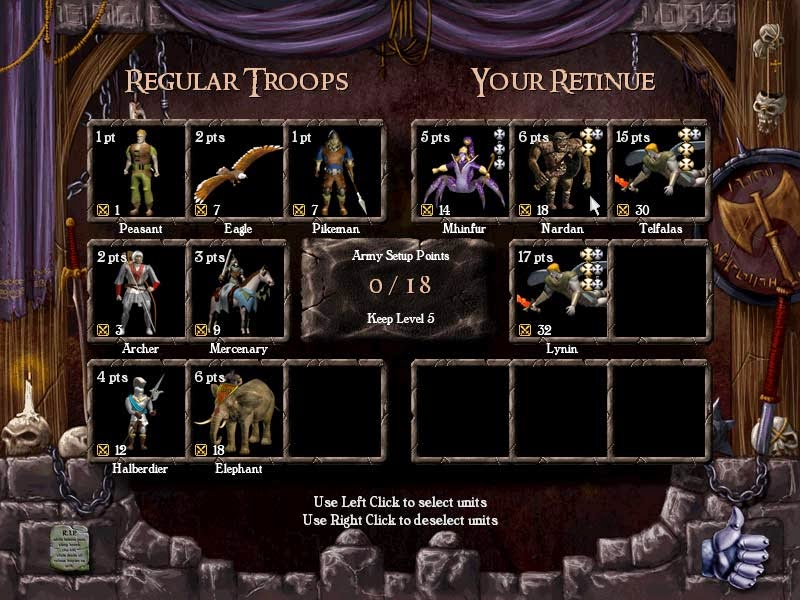
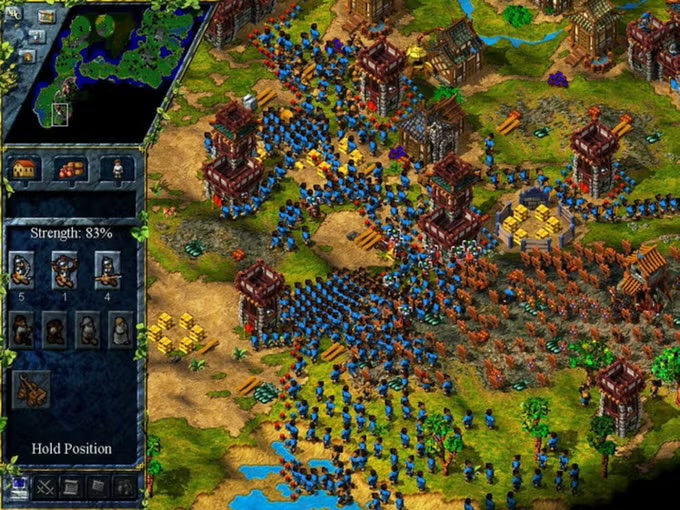
Reference: Warlords Battlecry III’s retinue screen. Your veterans follow your hero into the next battle, and I wanted that so badlyReference: The Settlers III. Hundreds of tiny people, every one of them doing something
Both of these are from my reference folder, not my game. Everything you see below is my own art built to that standard.
How I worked
I want to be upfront about this because I think it’s the interesting part. I didn’t hand-write the code. I worked with Claude Code as my engineer and I was the director, designer and the most annoying playtester alive.
My job was to know what the game should feel like and to keep saying “no, not that” until it did. I made the art & designs and played it every evening and wrote up what sucked.
Each playtest became a “bug fixing round”. Some rounds were tiny fixes. Some threw out the entire economy.
It started in a browser
Version one was a straight-up clone of Warlords Battlecry III running in a browser tab. Plain HTML canvas and JavaScript with no build step
Then I bolted the Settlers economy onto it: around 30 goods, 25 professions, 33 buildings, carriers who walk goods around, woodcutters who actually chop trees, foresters who plant saplings that grow into forest.
It worked! It also looked like a pixel-art prototype, and that wasn’t the game in my head. I moved the whole thing to Godot 4 and started again on the art.
Finding the look
I built a Pinterest board and gave myself a brief: not low-bit pixel art. Stylised, texture-painted 3D, rendered down to isometric sprites. Fantasy, but a little gritty. Not too cartoony, not grimdark either.
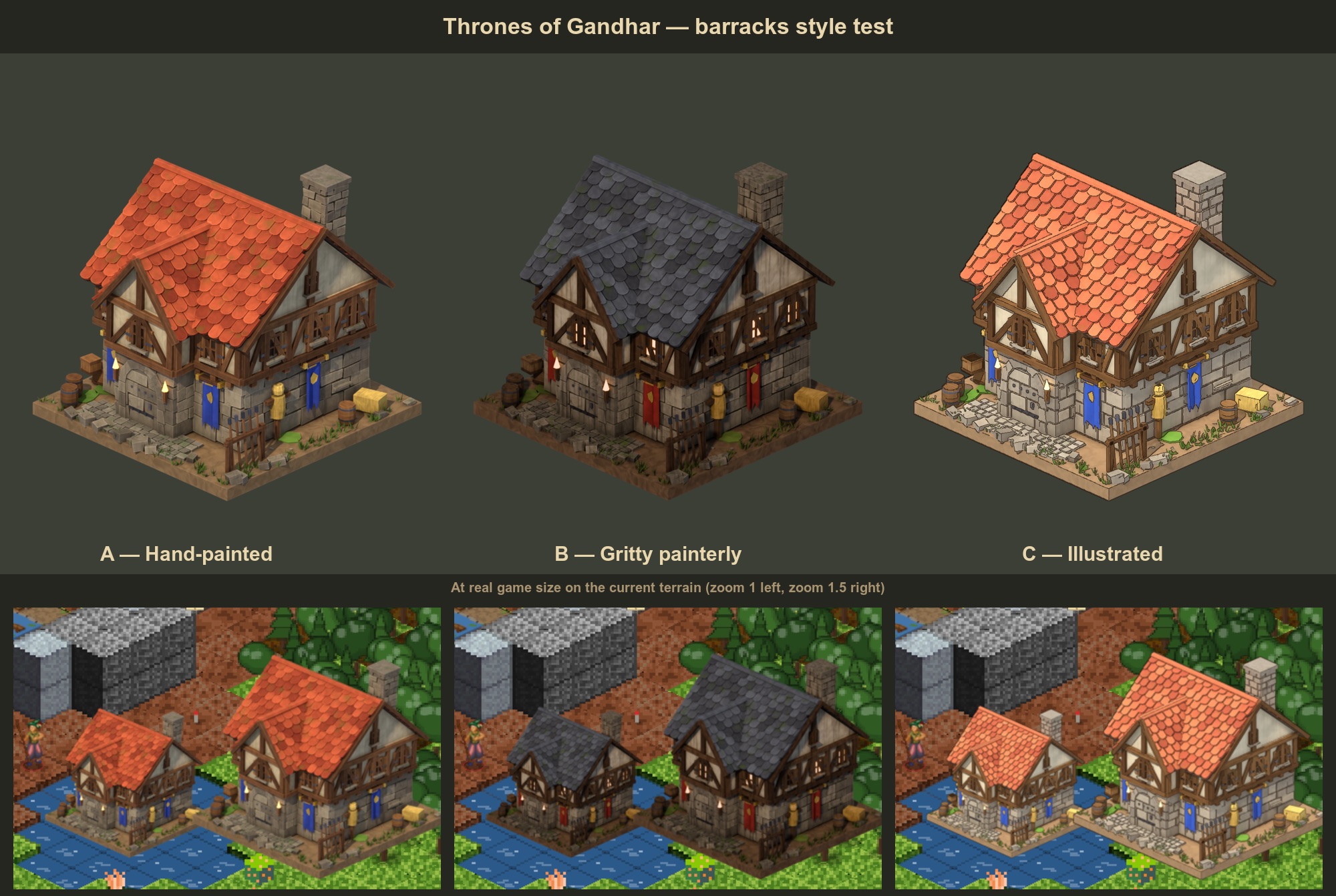
To actually decide, I rendered the same barracks in three looks and put them side by side, both close up and at real in-game size on the terrain.
A was nice but a bit soft. B was moody but went muddy at game size, you just lost the building. I picked C, the illustrated one.
Seeing them at actual game size (the bottom strip) was the thing that decided it. Something that looks gorgeous at 900 pixels can turn into a brown blob at 90.
Every stone is real
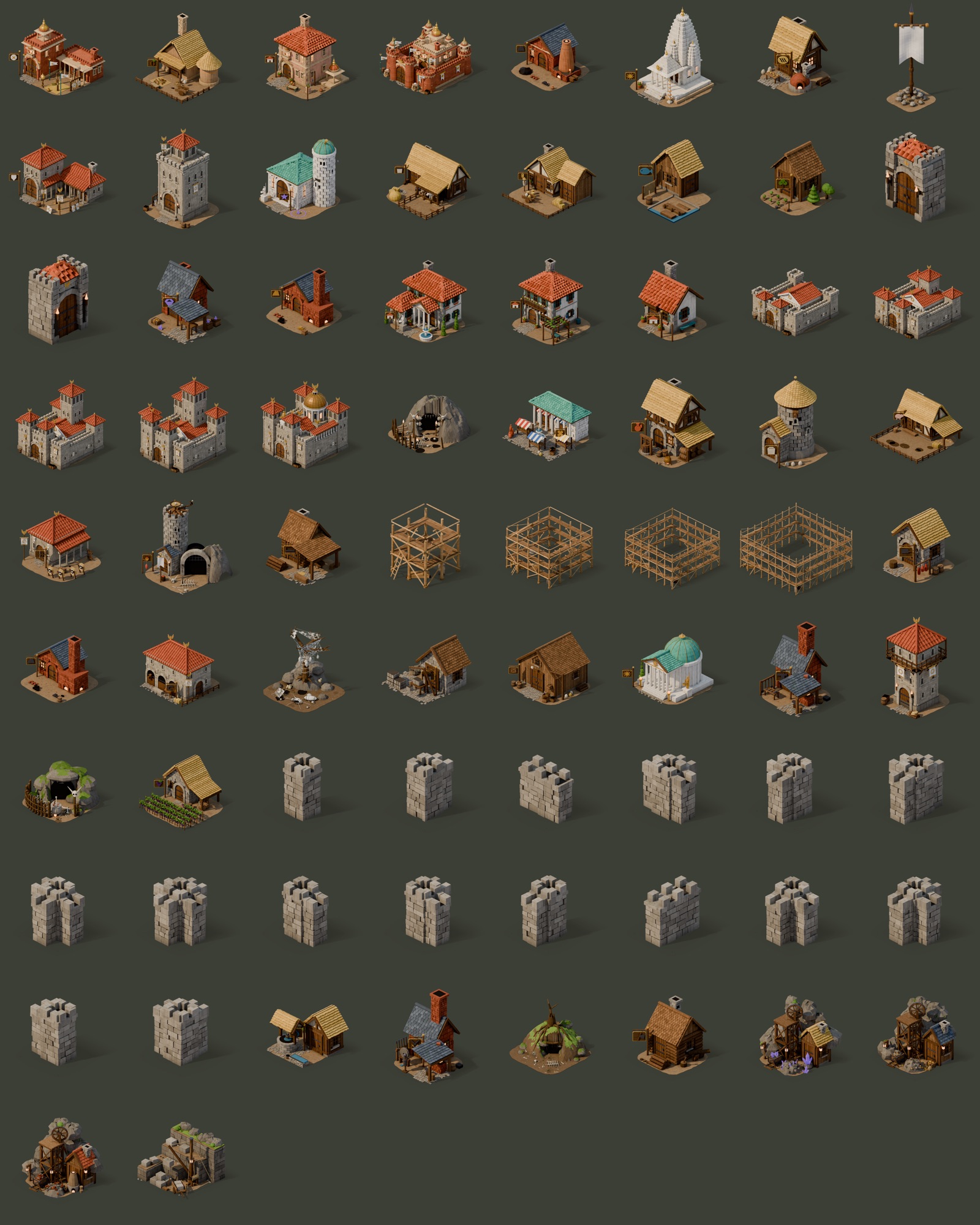
This is the part I’m kind of obsessed with. Every building is modelled in Blender stone by stone and tile by tile. Every roof tile, plank, beam and log is actual geometry, then a hand-painted shader adds worn edges, grime creeping up from the ground, moss, cracks, and the odd missing tile for grit.
The full building set at one point. Homes, workshops, mines, temples, five keep levels, construction scaffolds and every wall piece. All built in Blender.
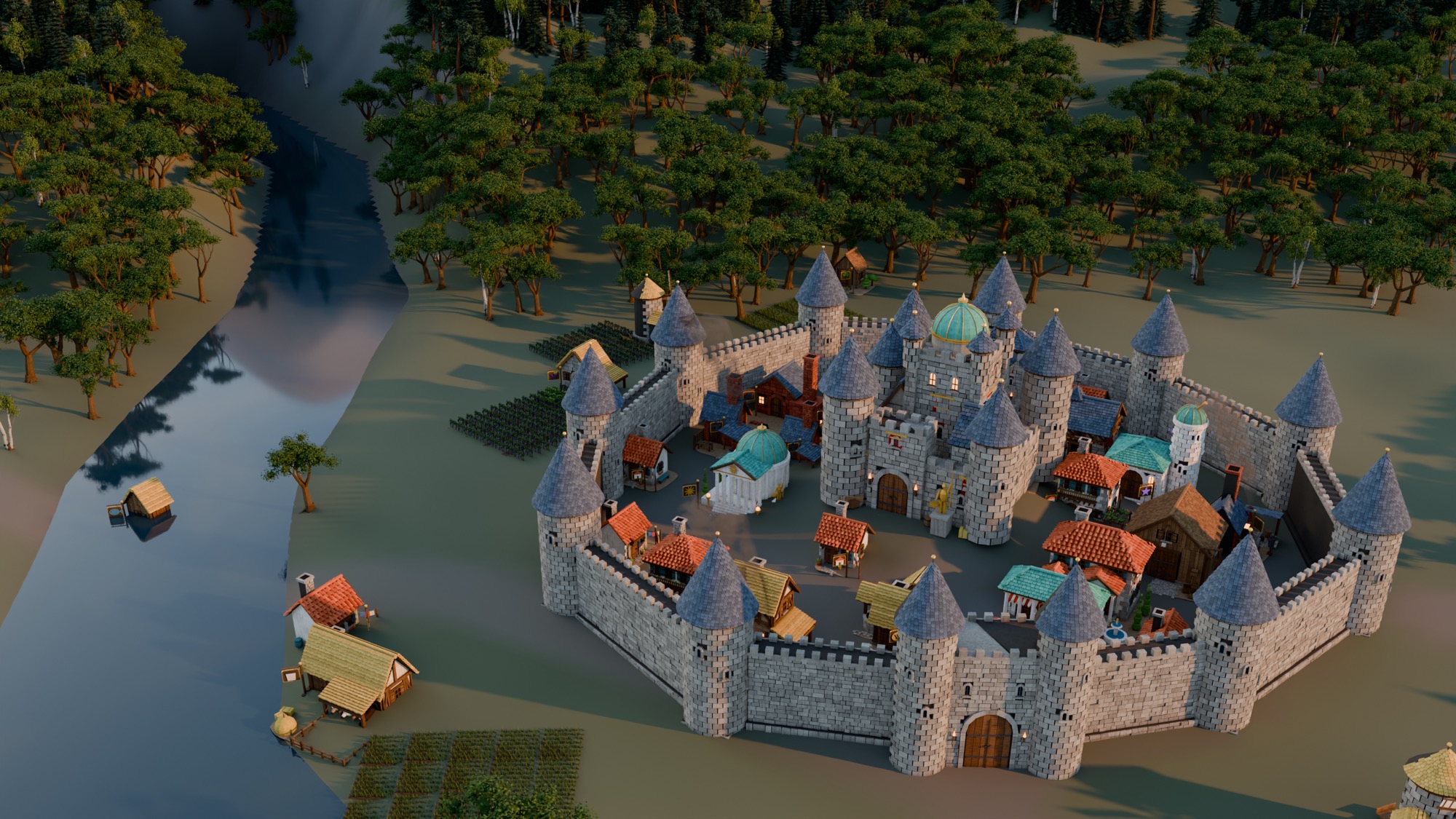
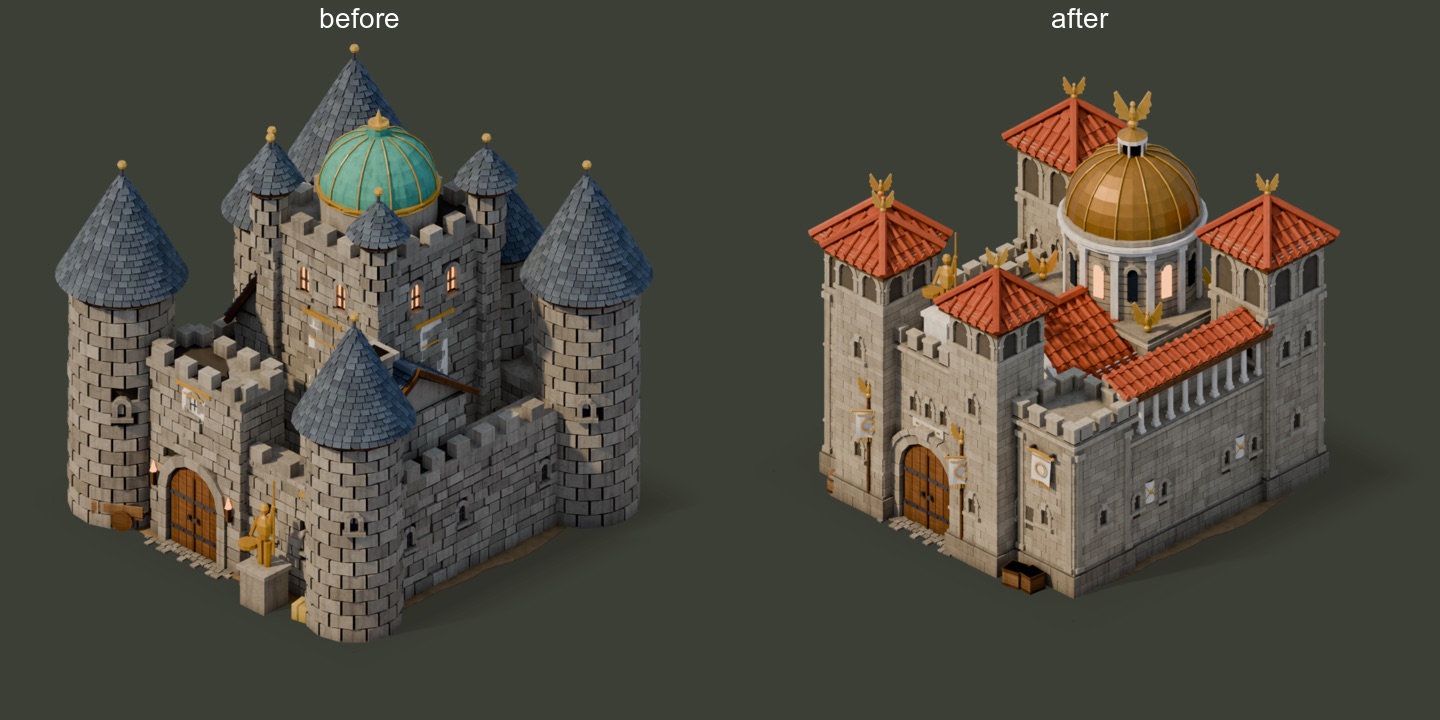
The level 5 keep, before and after. The first version was a fairytale castle with blue cone roofs, which looked cool on its own but didn’t match the rest of the world. When the humans in my game became the Valerians, a Roman-ish people, the keep went terracotta, with a gilded dome and eagles on top.
The world
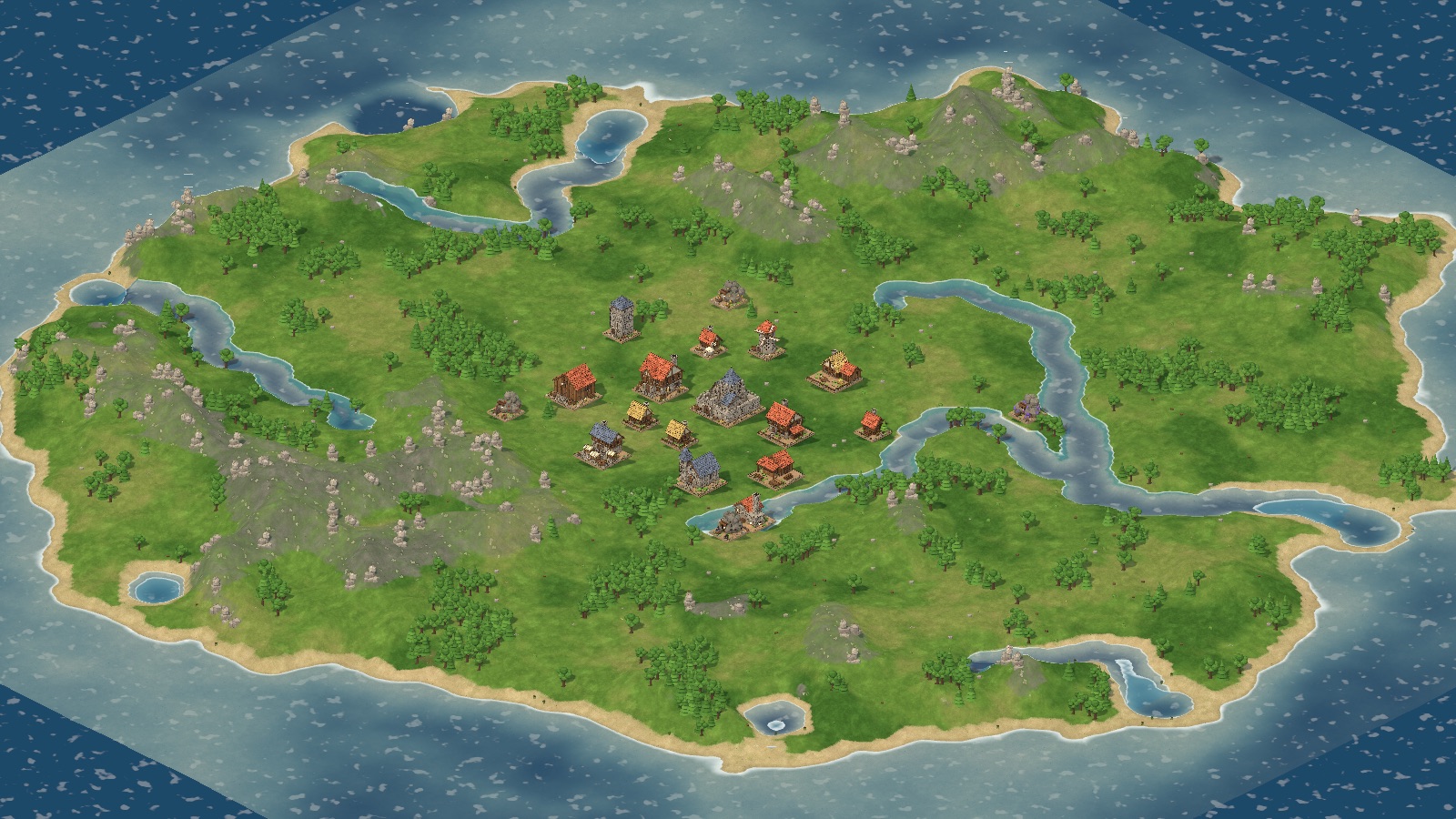
Every map is a randomly generated island. Hills and ridges, rivers that actually flow downhill to the sea and join up as tributaries, ponds, beaches. You can wade across a river, slowly.
Later rounds added tall mountains nobody can cross except flyers (the game cuts a pass if they’d wall a kingdom off), and biomes. Desert slows you down and won’t grow crops. Tundra is even slower, and horses hate it.
A whole island from way up. That little cluster in the middle is a town that’s just getting started.
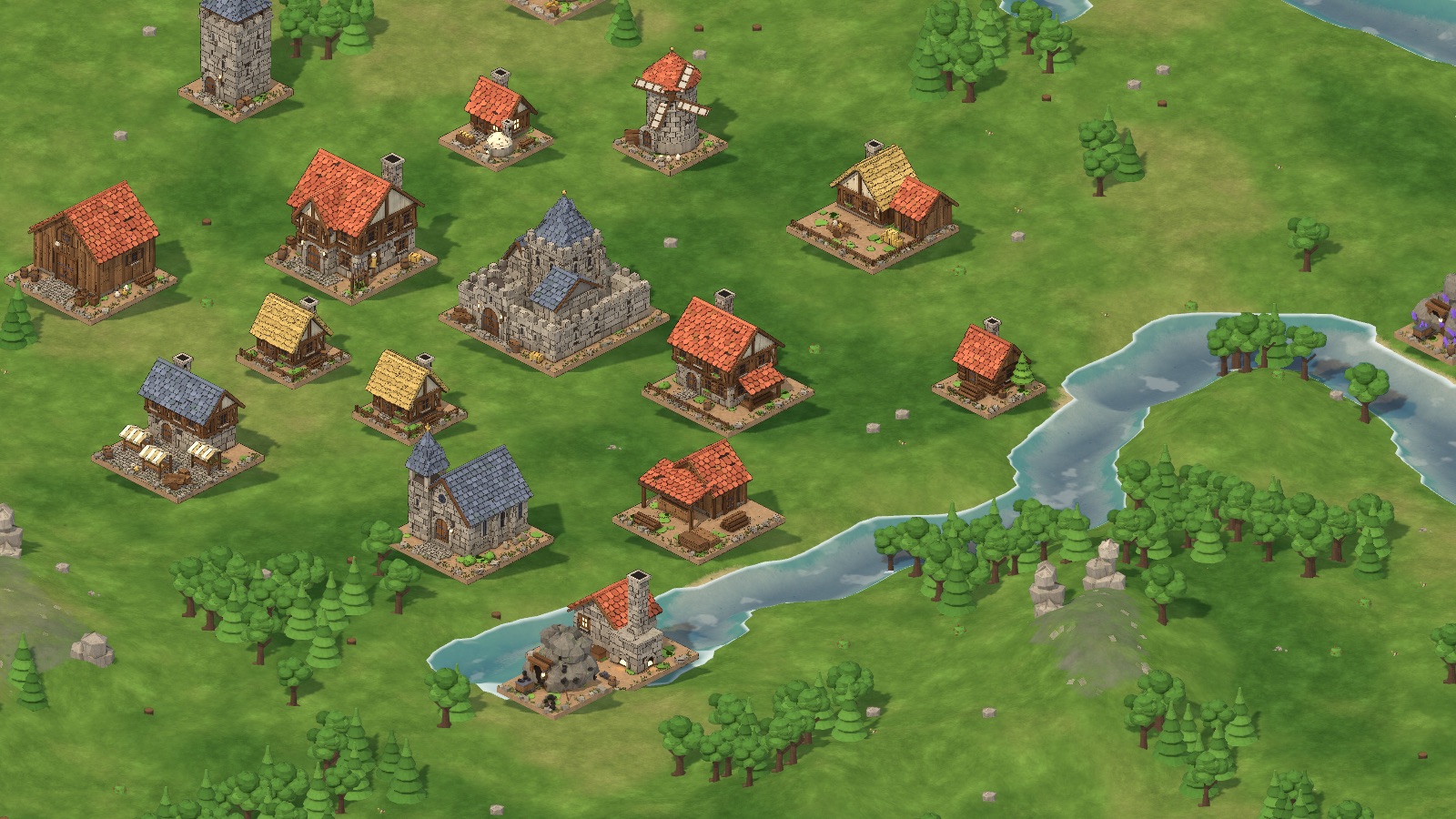
Closer in. I love how the river cuts through and the mill sits right on the water. Woodcutters, foresters, farms and fishermen all work in an area around a centre point you can move, just like Settlers.
The people
Characters were their own little saga. My first rule for them was “pre-rendered and realistically proportioned, like Warlords”. Then I played it and realised I actually wanted the Settlers feel: stocky little people you can read from far away.
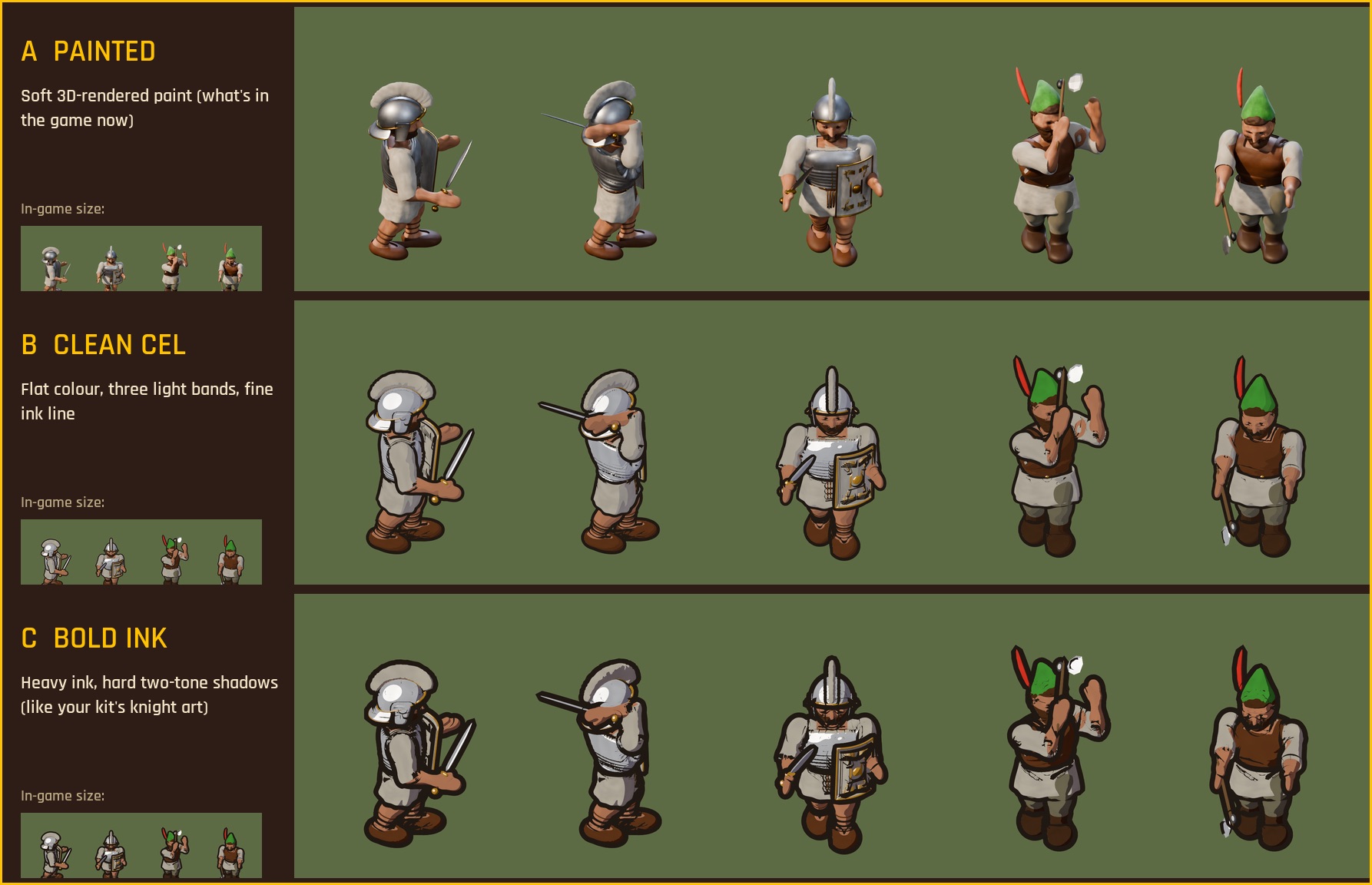
So we went stocky. Bigger heads, bigger hands and feet, slightly shorter legs, oversized tools. And every trade got its own signature hat so you can tell who’s who at a glance: green felt cap with a red feather for the woodcutter, a brass helmet with a lamp for the miner, a straw hat for the farmer, a white toque for the baker.
Same trick as the buildings: three rendering styles, side by side, with an in-game size preview for each. I’d already learned that heavy ink lines read as cartoon, so the bold ink option was more to prove a point than anything.
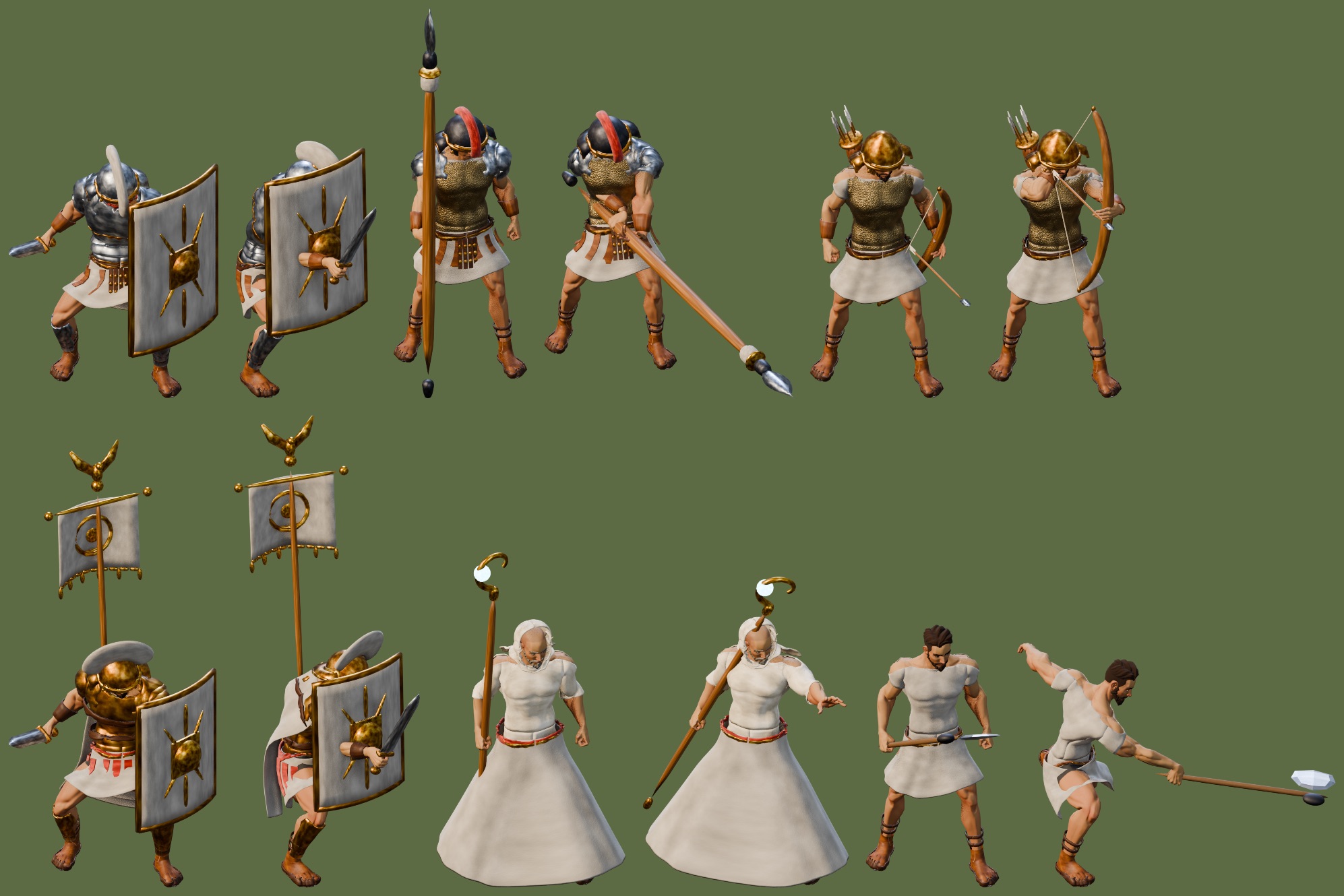
The Valerian army. Men-at-arms with big curved shields, pikemen, bowmen, the hero carrying the kingdom’s standard, a wizard, and a worker mid-swing. The armour is built as shells on top of the body so it bends with it, and both hands actually grip the pike. Little details, but you feel it when they march.
“It looks good, but it isn’t fun”
This was my verdict after round five, and honestly it’s the most important thing that happened on this project.
By then the economy was super deep. Households slowly grew settlers if you fed them. Recruits came out of your population. There were tools for every profession, a toolsmith, an armsmith, around 30 goods. On paper it was everything I loved about Settlers. In practice I was spending all my time staring at shortages and none of it having fun.
So I rewrote the spec. Round six threw out the population mechanic completely and squeezed the economy down to five resources, each with exactly one processing step:
Resource
Raw source
Processed at
You get
Wood
Woodcutter
Sawmill
Planks
Stone
Rock quarry
Stonecutter
Stone
Iron
Iron mine
Iron smelter
Iron ingots
Gold
Gold mine
Gold smelter
Gold ingots
Gems
Crystal mine
Gemologist
Gems
Buildings now bring their own worker. Carriers come from a Carrier House. Soldiers cost materials, not people. You still watch everything get carried around, which is the magic, but you’re not babysitting two seperate things anymore.
Then in the very next playtest I flipped the pacing too: resources are plentiful, the supply chain is the bottleneck. Every chain yields double and you start with about three times more stuff. Suddenly both computer kingdoms were maxing out their keeps around minute 20 to 35 and the war itself lasted 40+ minutes. That’s the game I wanted.
The lesson I keep coming back to: depth isn’t the same as fun. Cutting stuff I loved made the game better.
The interface
My two launch requirements were: a good readable UI. So the UI went back to the Warlords layout I grew up with. Slim bar on top with your five resources, food, mana, army size and carriers. At the bottom: minimap, hero portrait with health, mana and XP bars, a display area for whatever you’ve selected, and a command grid.
For the skin, I built dark bronze buttons that light up molten gold when you hover, bronze-rimmed slots with a grungy texture, parchment strips, dark panels.
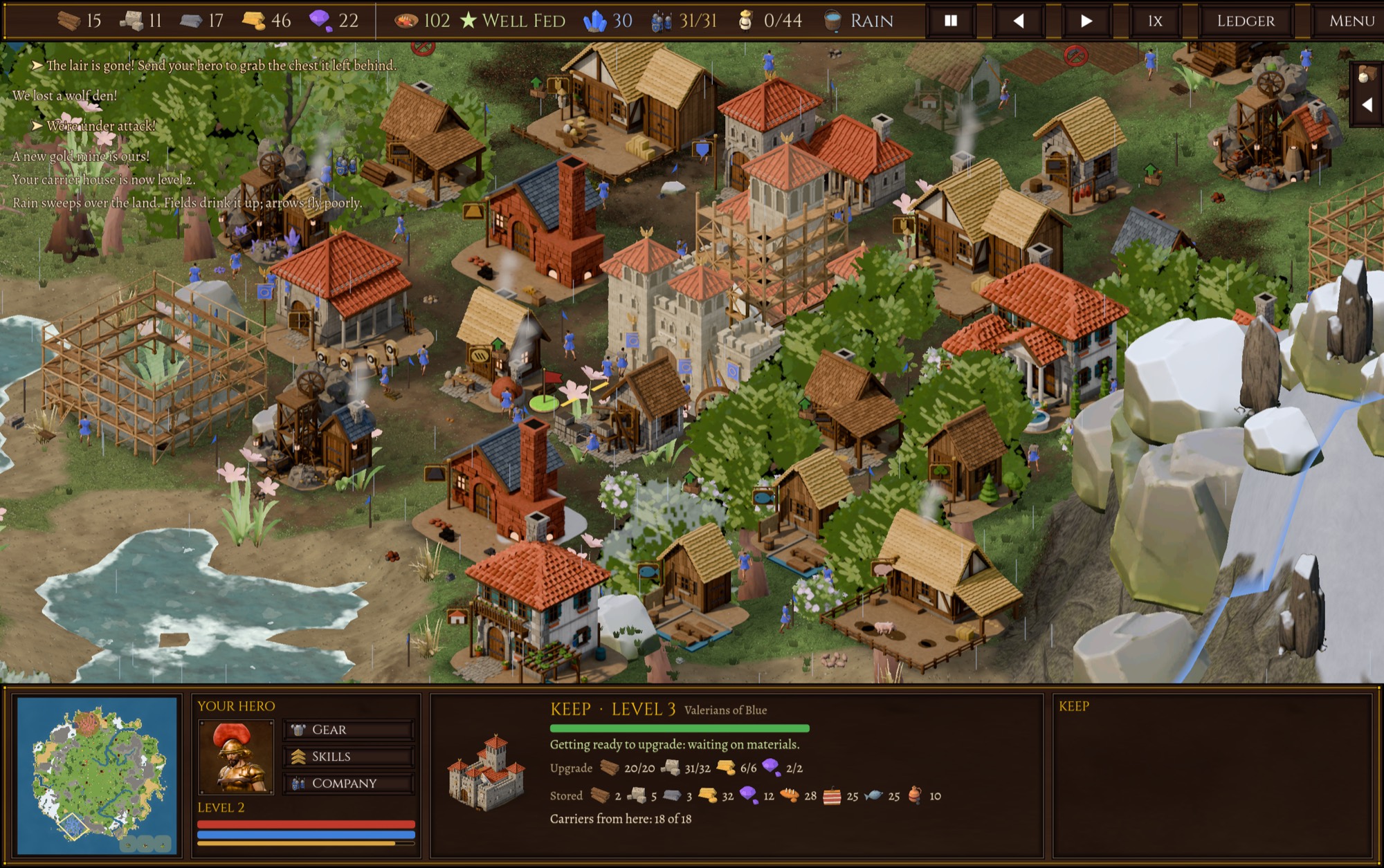
This is what a mid-game town actually looks like. It’s raining (fields grow faster, arrows fly worse), the keep is waiting on materials to hit level 4, and there’s a scaffold going up around a new building. Notices on the left are clickable and jump you straight to the thing.
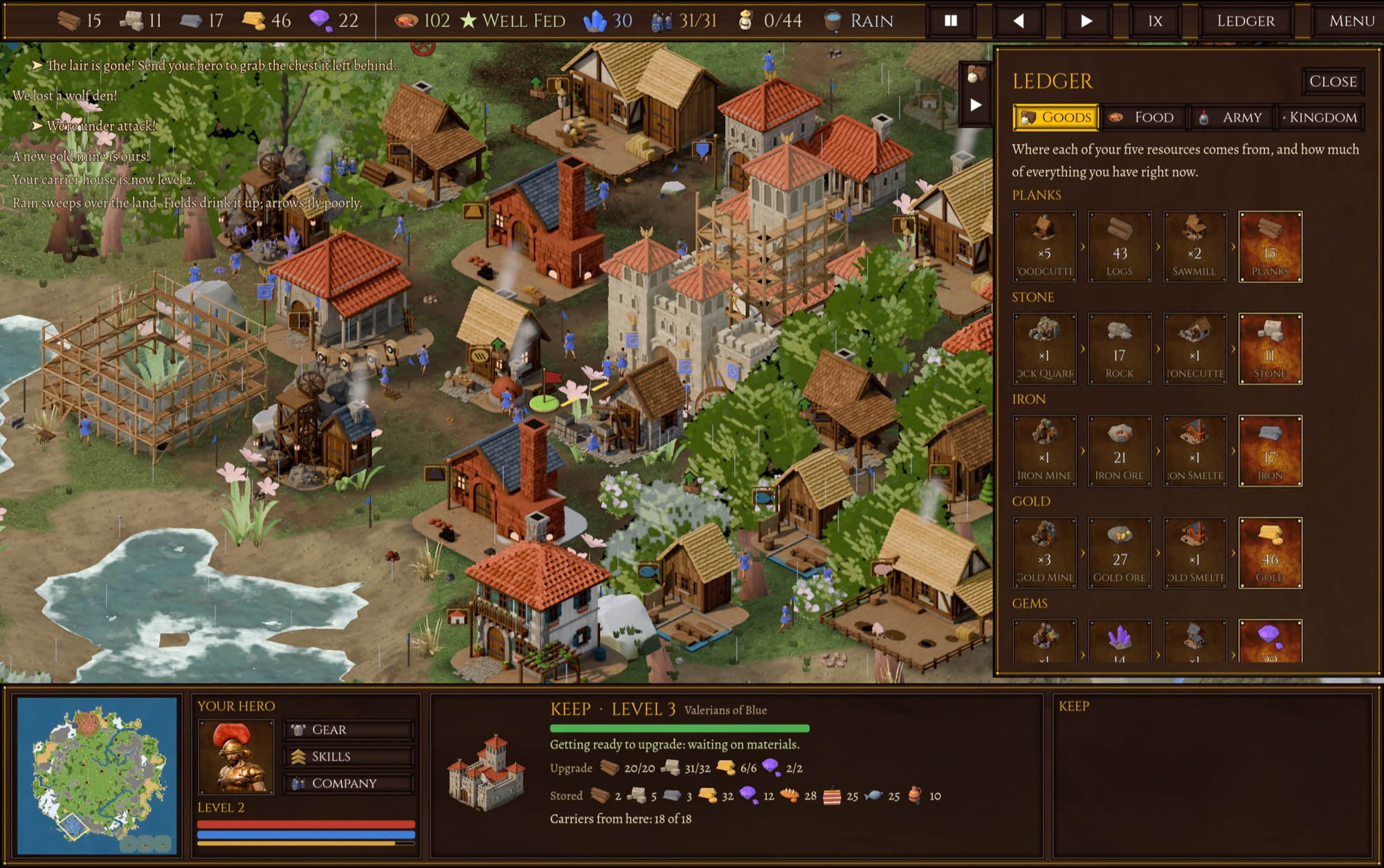
The Ledger. Press Tab and you see every resource as its little chain, left to right: how many woodcutters, how many logs waiting, how many sawmills, how many planks. When something’s stuck you can see exactly where. This screen only works because I cut the economy down to five one-step chains.
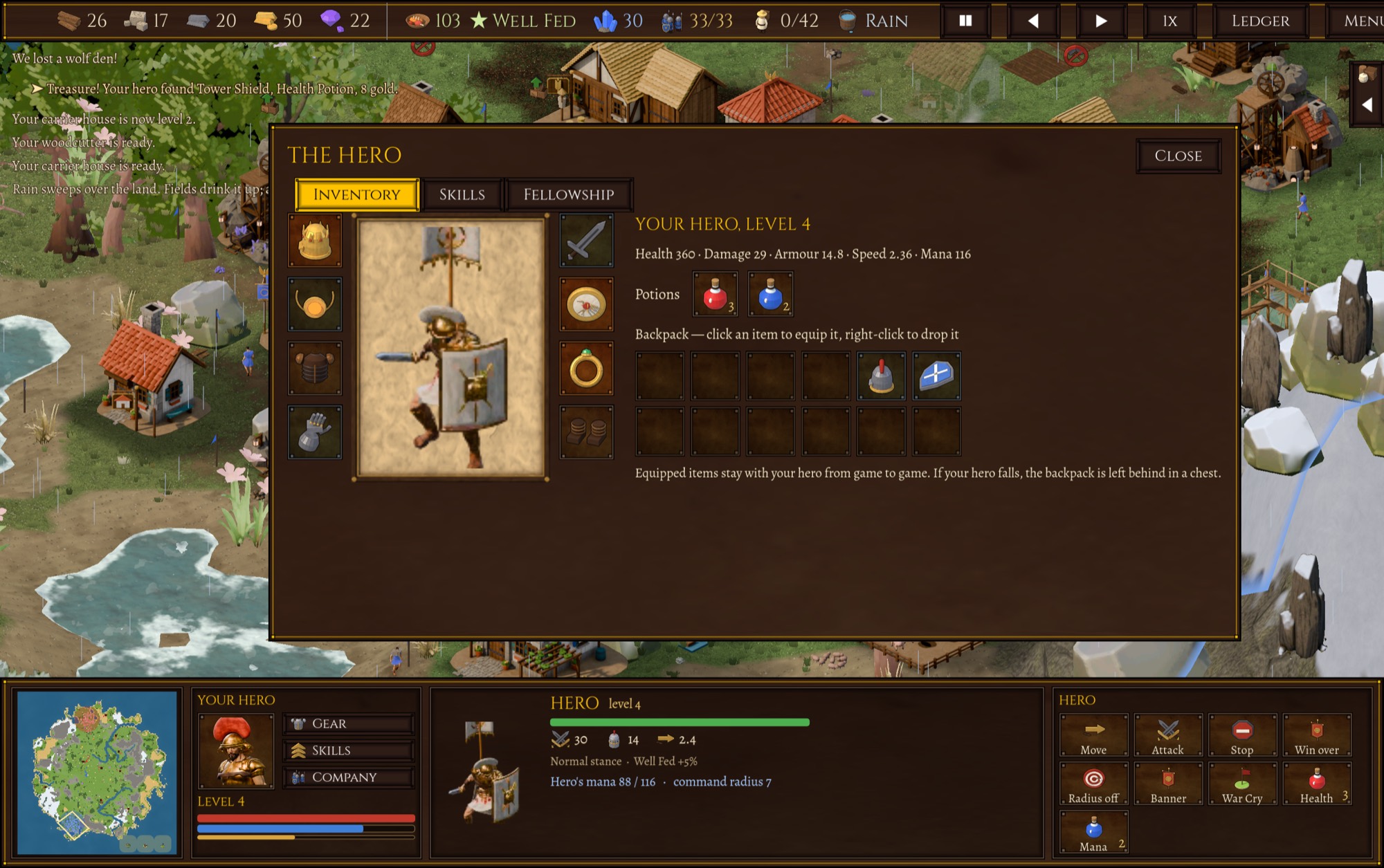
Your hero gets a proper paper doll: eight equipment slots around them, a 12-slot backpack and a potion belt. Gear comes from treasure chests and monster lairs and carries over between games. If your hero dies, their backpack drops in a chest right where they fell. I love it.
At the end of a game your best veterans can join the hero’s Fellowship. They’re named, they keep their rank, and they start next game standing beside you. If they fall, they go to the graveyard. Yes, I get attached.
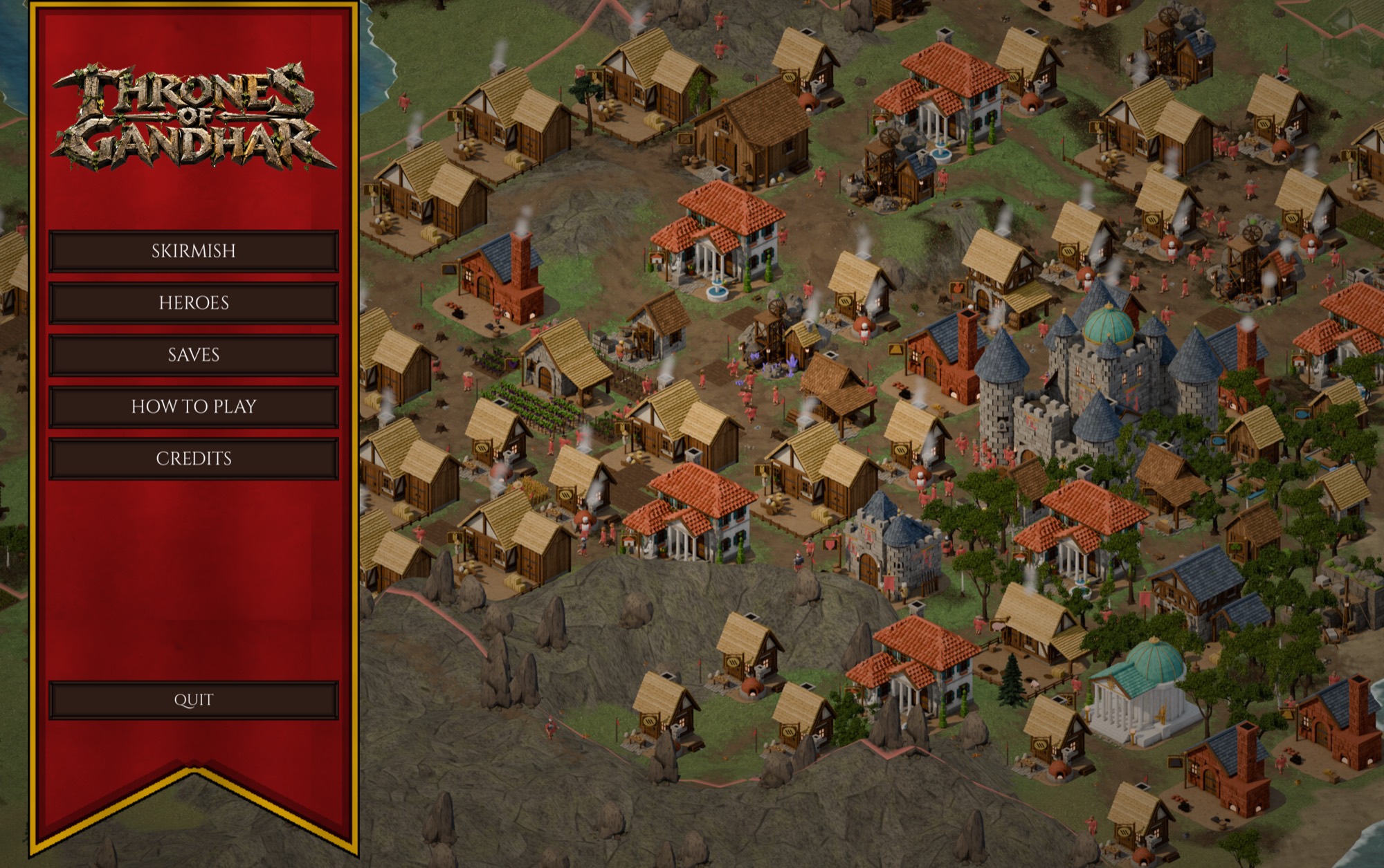
The title screen, with my stone-and-ivy logo on a red banner. Behind it is a (older verison) big late-game town, which I think says “this is what you’re building towards” better than any tagline could.
The war part
A few of my favourite things on the military side:
Tower capture duels. Regular troops can’t knock down a defended tower, they have to take it. At 70% health it opens up for one-on-one duels: one defender steps out, one attacker steps up, everyone else waits. Winner holds the ground.
The phalanx. Four or more Valerian men-at-arms or pikemen can lock shields. They get a lot tougher and arrows barely touch them, but they’re slow, and dragons absolutely wreck them
Blessings. The temple turns wine into mana, and mana levels up a whole branch of your army at once (foot, archers, riders or mystics), including soldiers already on the field
Food morale. A well-stocked kingdom fights better. Well Fed, Feasting, Abundance, each one a bit more damage and armour
Weather. Rain makes fields grow faster and arrows worse. Snow slowly creeps over everything, slows everyone down, and eventually freezes the rivers so your fishermen just stop
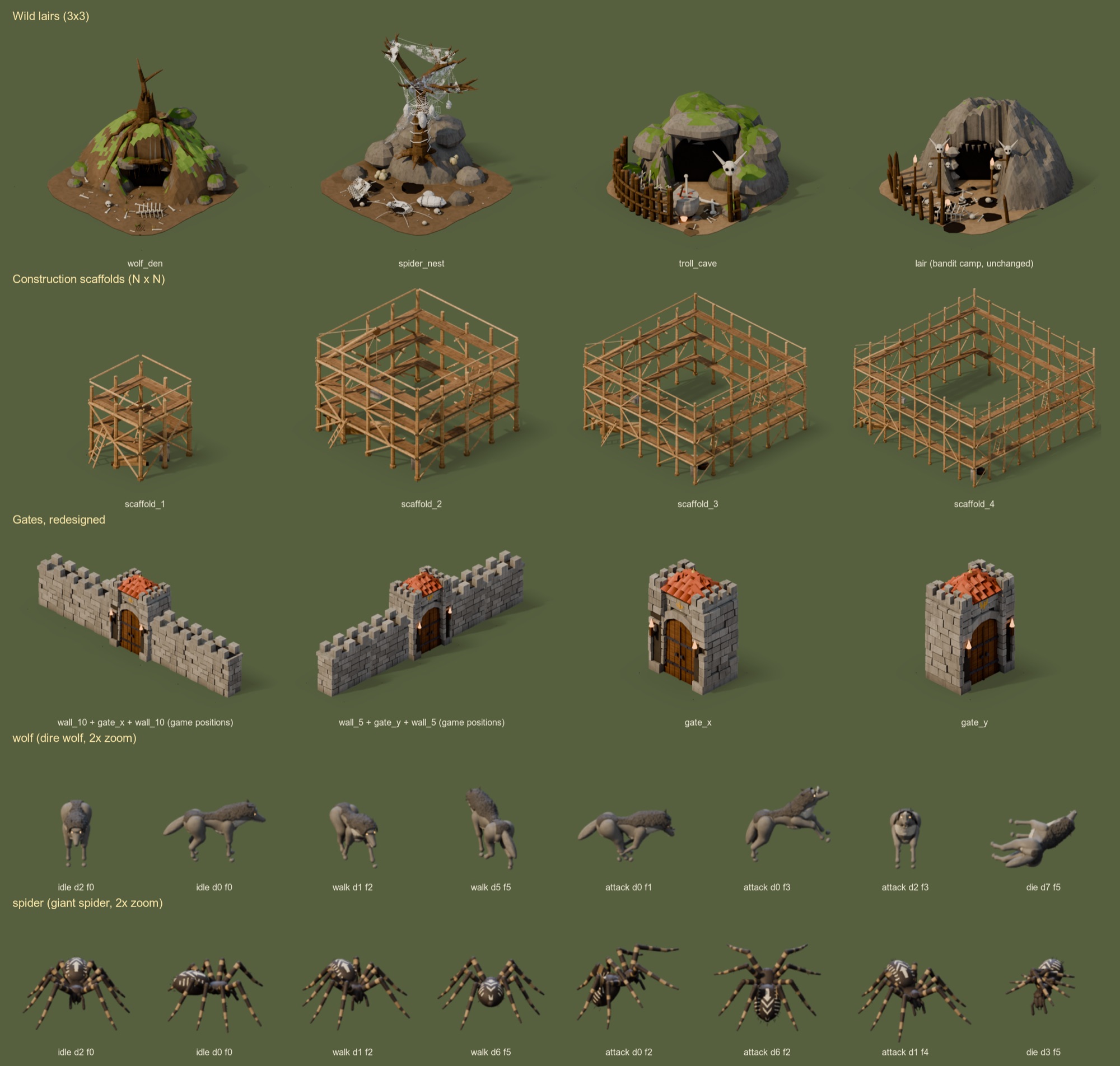
The wild stuff. Wolf dens, spider nests, troll caves and bandit camps guard most of the mines on the map, and each one keeps raising new guards. Clear one and your hero gets a chest. There’s also an Ancient Dragon asleep on a hoard in the middle of the island. Good luck.
A second people
The game’s called Thrones of Gandhar for a reason, so a faction rooted in Indian history was always the plan. So I brought in the Aryavartans.
They share every system with the Valerians but have their own names, recipes and art. Their homes are haveli-themed. Their food comes from walnut farms, mango farms and cattle farms, and their mana comes from a Soma Brewery instead of wine. They train war elephants that wreck buildings and Garuda as flyers, and once a game they can call down Indra, a demigod who throws lightning.
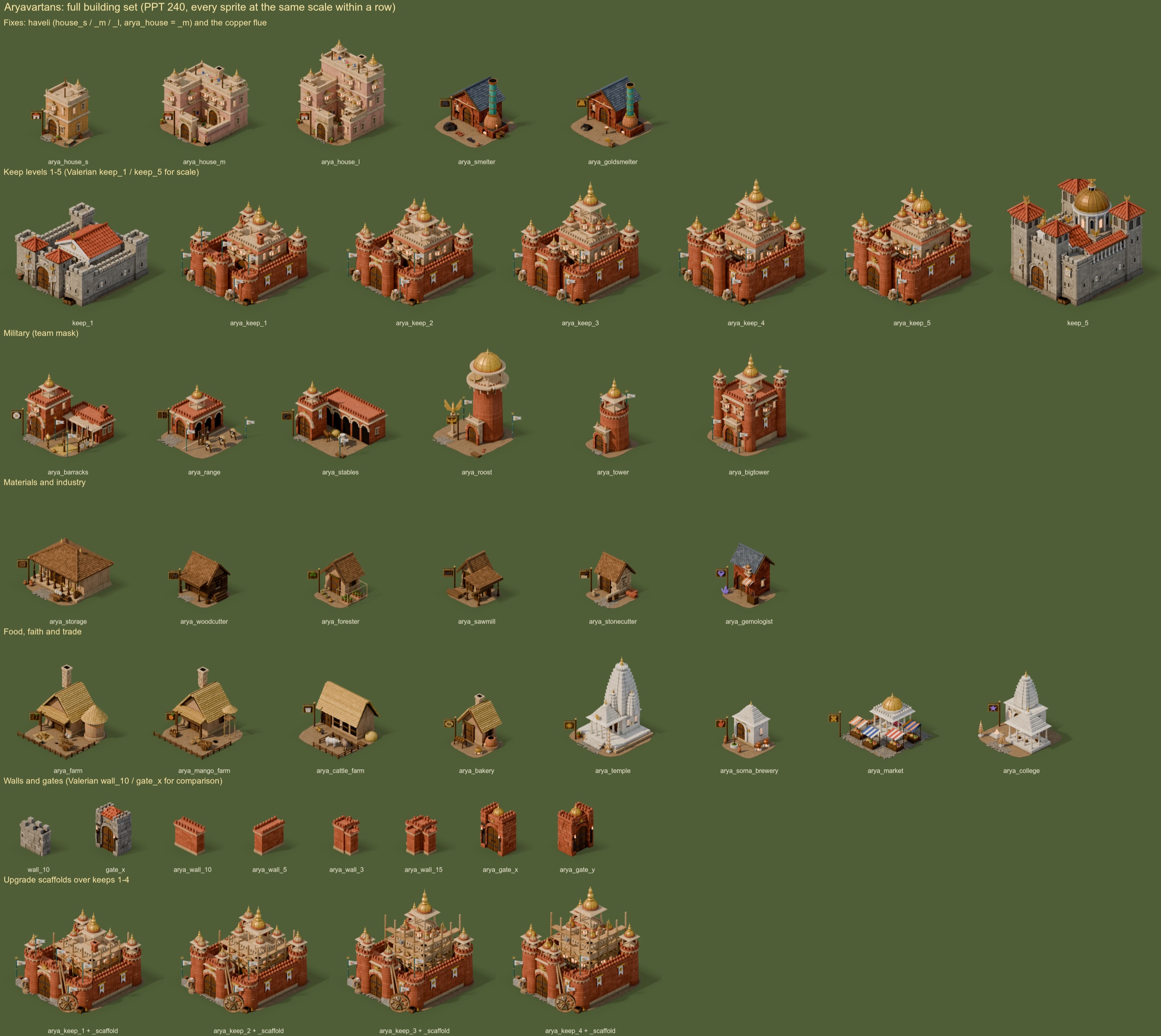
The full Aryavartan set: havelis, keep levels one to five (with upgrade scaffolds), military buildings, workshops, farms, temples, walls and gates. Red sandstone and gold domes against the Valerians’ grey stone and terracotta. You can tell who owns a town from across the map.
Making it run
Pretty art has a cost, and I found out the fun way: scrolling started stuttering. Turns out the unit sprite sheets were huge and uncompressed, around 150 MB of video memory per unit type. Oops.
I shrank the sheets, compressed them properly, loaded them in the background when a game starts, and moved the minimap drawing onto the GPU (it had been freezing the game for about 145 ms every second). An early game went from about 40 fps to a solid 60 on my M2 MacBook.
Same energy on the computer opponent: finding a spot for a farm used to take 210 ms. It now takes 8 ms, with identical results.
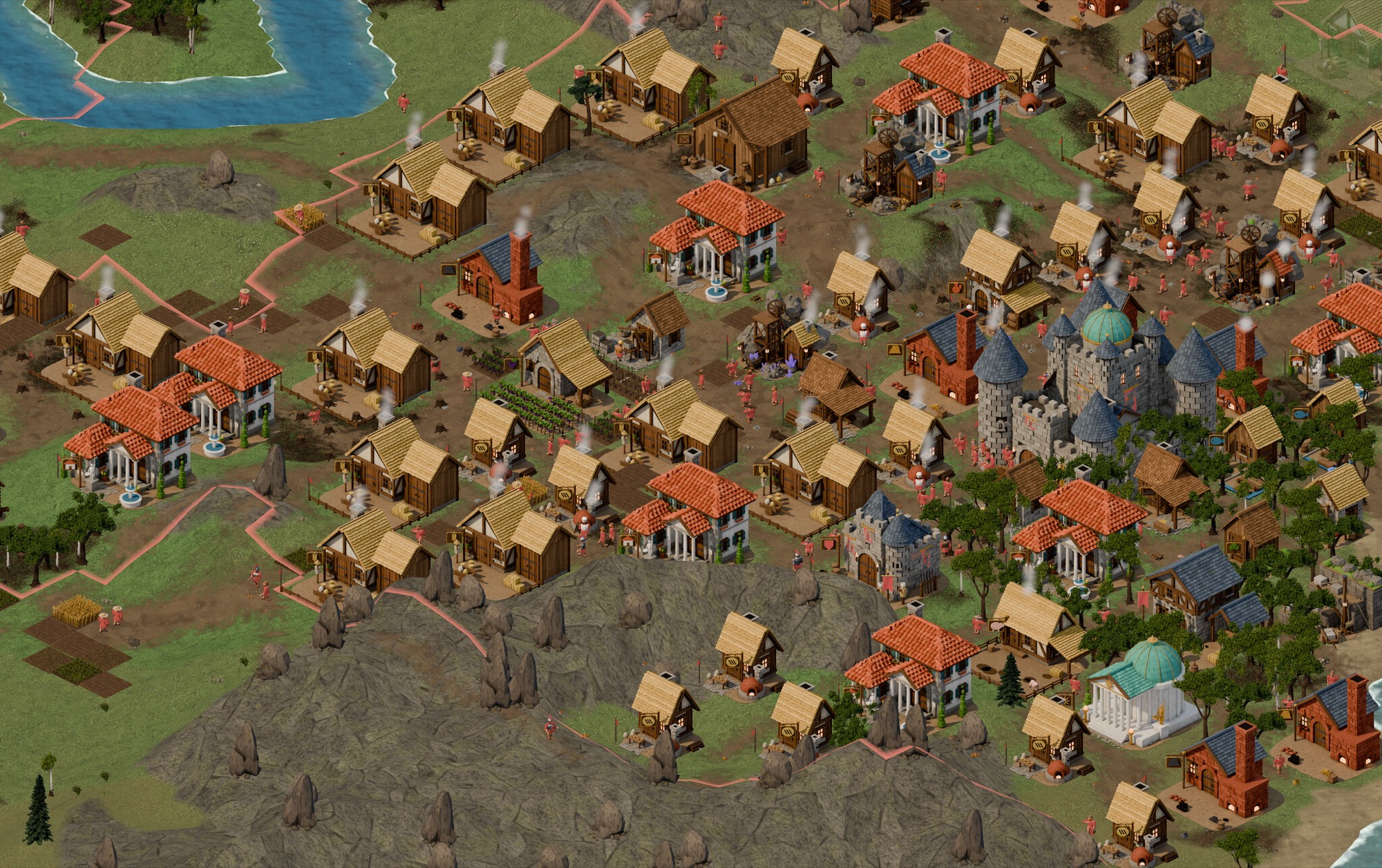
This is why performance mattered. A late-game town is packed with buildings and people, and every one of them is walking somewhere with something on their shoulder. Chimney smoke means a workshop is busy. I could watch this all day. I have.
What I learned
Play it, every day. Every big decision on this project came out of a playtest. “It isn’t fun” is a useless sentence in a meeting and the most useful sentence in the world after an hour of actually playing.
Compare things side by side, at real size. The style tests saved me from at least two wrong calls. Always look at the thing the way the player will see it.
Rules make a world. Symmetrical windows and hollow chimneys sound like nitpicks. But a hundred buildings following the same rules is what makes it feel like a place.
Directing is a real skill. As a designer my job is mostly taste.
What’s next
More peoples are sitting in the data waiting for their turn, along with wall designs and a proper balance pass on the computer opponents. It runs on Mac and Windows already. If you grew up on these games like I did and want to try it, send me a message.